About this episode
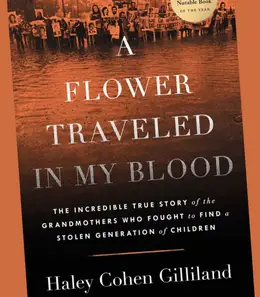
Today I’m speaking to the remarkable author and journalist Haley Cohen Gilliland, whose nonfiction book A Flower Traveled in My Blood reads like a novel, but is entirely true.
Haley’s book - which The New York Times and The Washington Post among others named one of the best books of 2025 - tells the story of the Argentine grandmothers who fought to find a stolen generation of grandchildren.
Haley’s account weaves together a family saga, a forensic detective story and a sweeping human rights history. At its heart are the grandmothers who used their perceived status as harmless “little old ladies” to move beneath the radar of Argentina’s military and police, organising quietly but relentlessly in search of the truth.
A bit of background.
During Argentina’s military coup of 1976, the junta launched what it called the National Reorganization Process, a chillingly bland name for a brutal dictatorship. Over the years that followed, thousands of Argentines forcibly disappeared. Human rights groups estimate the number could be as high as 30,000.
Among the regime’s most horrific crimes was the systematic abduction of pregnant mothers. Women were held in clandestine detention centres, gave birth in appalling conditions, and were then murdered. Many were drugged and thrown from planes into the Río de la Plata or the sea to erase evidence. Their babies were taken and placed with families connected to or sympathetic with the regime, often under false identities.
The distraught mothers of these young women began gathering in Buenos Aires’ Plaza de Mayo. From this movement emerged the Abuelas de Plaza de Mayo, the Grandmothers of the Plaza de Mayo, who realised they would have far greater power working together than searching alone.
Haley’s compelling and deeply moving book follows these women over decades, their courage, their strategy, their painstaking documentation, and eventually the scientific breakthroughs that allowed them to identify stolen grandchildren through genetic testing.
We talk about the extraordinary reunions, moments of joy and relief, but also about the pain and identity confusion experienced by many of the grandchildren when they learned the truth. We reflect on how Argentina, as a nation, continues to grapple with this dark chapter in its history.
This is a conversation about memory, justice, science, motherhood, and collective love that proved stronger than fear.